Can LLMs Make Scientific Discoveries?
A causal simulation and some notes on what it takes to turn a plausible explanation into a scientific claim.
By Richard Sarpong
I am not convinced that the question of whether LLMs can make scientific discoveries has a useful yes-or-no answer yet.
One side of the discussion treats language models as pattern-matching systems that can only recombine existing knowledge. The other points to increasingly capable agents and suggests that autonomous scientists may already be emerging. Both framings seem to put too much weight on what a model can do by itself.
Here, I want to examine a narrower distinction: finding a convincing relationship in data is not the same as establishing an explanation for it. I used a synthetic causal experiment to make that distinction concrete, before considering what it means for AI-assisted research.
My current hypothesis is that scientific discovery is better understood as a systems capability: something that emerges from the interaction between models, tools, experiments, evaluators, data and human judgment. The simulation below illustrates one requirement of such a system. It does not test the capabilities of a language model.
A relationship that disappears under intervention
For this article, I used a small synthetic simulation to illustrate the difference between finding a relationship and establishing a cause.
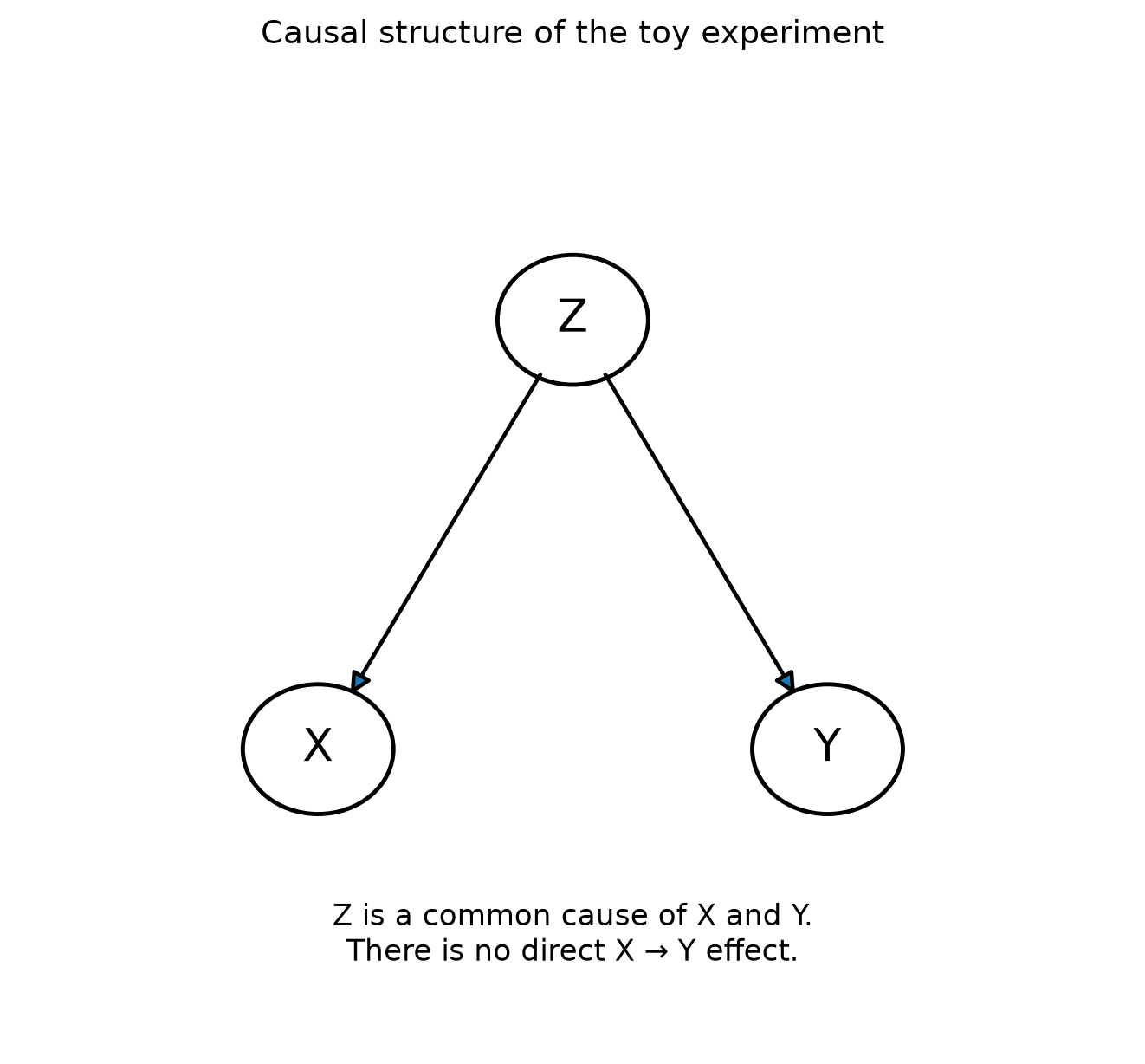
The simulation contains three variables: X, Y and Z. The data-generating process is:
Variable Z causes both X and Y. There is no direct causal relationship between X and Y.
The observational relationship
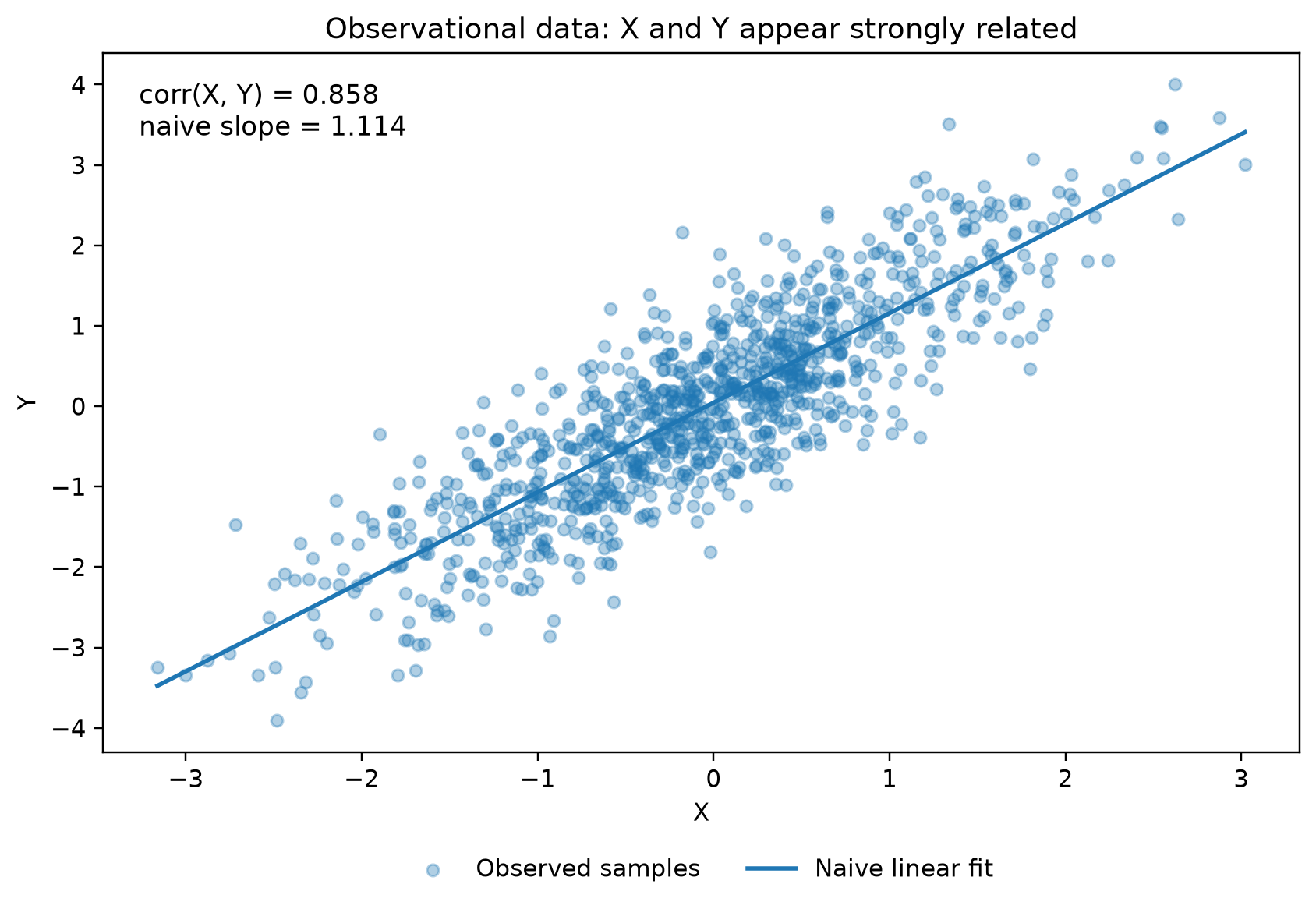
Using 1,000 generated observations, the simulation produced an observational correlation of:
That is a strong relationship.
A simple regression of Y on X produced a slope of approximately:
Looking only at those results, someone could construct a convincing explanation in which increasing X causes Y to increase.
Adjustment and intervention
However, when the common cause Z was included in the regression, the estimated coefficient for X fell to:
The apparent relationship was being produced by Z, not by a direct effect of X on Y.
I then simulated an intervention.
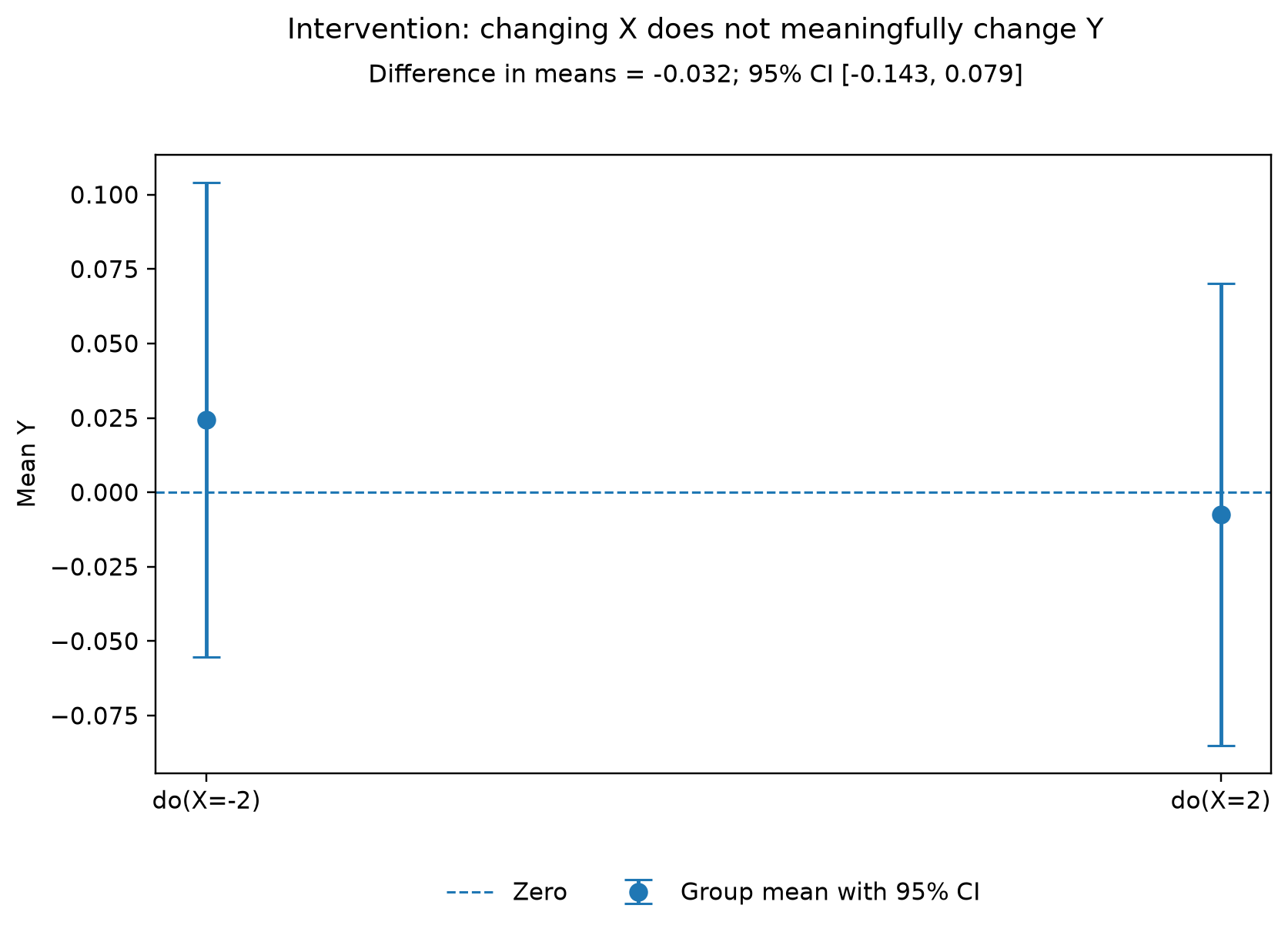
In one group, X was set to -2. In another, X was set to 2. Because X does not cause Y, changing X should not systematically change the outcome.
The estimated difference in mean Y between the two intervention groups was:
The 95% confidence interval was:
The interval includes zero, and the observed difference is small relative to the natural variation in Y.
| Metric | Value |
|---|---|
| 1 · Observation | |
| corr(X, Y) | 0.858 |
| Naive slope in Y ~ X | 1.114 |
| 2 · Adjustment for Z | |
| Adjusted X slope in Y ~ X + Z | -0.026 |
| Adjusted Z slope in Y ~ X + Z | 1.235 |
| 3 · Intervention on X | |
| Mean Y under do(X=-2) | 0.024 |
| Mean Y under do(X=2) | -0.008 |
| Intervention difference | -0.032 |
| 95% CI | [-0.143, 0.079] |
What this experiment does and does not show
The observational data made X appear strongly predictive of Y, but intervening on X produced no meaningful effect.
This experiment is not a benchmark of language models. It does not prove that any particular model would reach an incorrect conclusion.
Its purpose is narrower: to illustrate why scientific discovery requires more than identifying patterns in existing data.
A reliable scientific system must ask:
- Could another variable explain the relationship?
- Which assumptions are required for this analysis?
- What intervention would distinguish correlation from causation?
- What evidence would cause us to abandon the original explanation?
Scientific reasoning includes not only producing a hypothesis, but also identifying how that hypothesis might be wrong.
This is the distinction I want to keep in view when reading claims about AI and scientific discovery. A scientific discovery is not simply a sentence that sounds new. The process may include:
- identifying an unexplained observation;
- retrieving relevant prior work;
- generating competing hypotheses;
- producing testable predictions;
- designing an experiment;
- collecting and analysing evidence;
- rejecting alternative explanations;
- revising the original hypothesis;
- reproducing the result independently.
Current models can already assist with many of these steps. They can search literature, summarise findings, generate analysis code and propose possible explanations. But completing individual tasks does not necessarily mean that the model understands whether the resulting scientific claim is valid.
A program can execute successfully while using the wrong statistical method. A graph can look persuasive while hiding a confounding variable. A model can produce a polished mechanistic explanation even when the available evidence supports only correlation.
How I read the evidence on language models
The simulation gives me a way to frame the question, but evidence about language models has to come from studies that actually evaluate them.
SDABench evaluates 15 language models across descriptive, exploratory, inferential, predictive, causal and mechanistic scientific-analysis tasks.
The models performed well on descriptive analysis but deteriorated on problems requiring assumption selection, latent-process modelling and mechanistic reasoning. Even stronger models frequently struggled to select an appropriate analytical procedure, represent relationships between variables and draw conclusions supported by the evidence [2].
CausalGame tests LLM agents in interactive environments containing selection bias, measurement error and hidden confounders. Across 30 agents, the best system reached 68% survival against analytical optima of 78-85%, while only 5-7% of sessions received credit under the benchmark’s causal-reasoning criteria [3].
These results do not show that LLMs are useless for science. They show that fluency and workflow completion are not reliable substitutes for scientific reasoning.
A different kind of argument comes from Google DeepMind researcher Tom Zahavy. His position paper, LLMs Can’t Jump, argues that current language models may become highly capable at induction and deduction while still lacking abduction: the creative leap required to formulate a genuinely new explanatory hypothesis.
Zahavy uses Einstein’s development of general relativity as an example of a discovery that required more than pattern recognition or deriving consequences from existing assumptions [1].
It is a provocative argument, but it is still a position paper rather than experimental proof that LLMs can never generate new scientific explanations.
I do not read these limitations as incompatible with the results from AlphaEvolve, Co-Scientist or FutureHouse’s Robin. Those results concern systems in which a model’s proposals are connected to evaluation and experimental work. That distinction matters to my interpretation.
What the surrounding system contributes
Some of the most impressive AI-assisted discoveries have occurred in systems where model outputs can be tested repeatedly.
AlphaEvolve uses language models to propose changes to algorithms. Those candidates are then executed, scored and filtered by automated evaluators. Weak proposals are rejected, while stronger ones become the basis for further iterations.
The system has produced improvements in mathematical algorithms and computational infrastructure, including provably correct results [4].
The model does not need to be trusted because its proposals can be evaluated.
Co-Scientist uses multiple specialised agents to generate, criticise, rank and refine scientific hypotheses. Researchers provide the scientific objective, guide the process and select hypotheses for experimental investigation.
The system contributed to biomedical hypotheses involving drug repurposing, treatment targets and antimicrobial resistance. Its laboratory validations explicitly retained experts in the loop [5].
FutureHouse’s Robin similarly combines literature-search agents with data-analysis agents.
Robin generates therapeutic hypotheses, proposes experiments, analyses returned laboratory data and uses the results to produce updated hypotheses. Human scientists still review candidates, execute physical experiments and interact with the system throughout the experimental loop.
The researchers therefore describe Robin as a semi-autonomous approach to scientific discovery rather than a completely independent scientist [6].
These systems share an important structure.
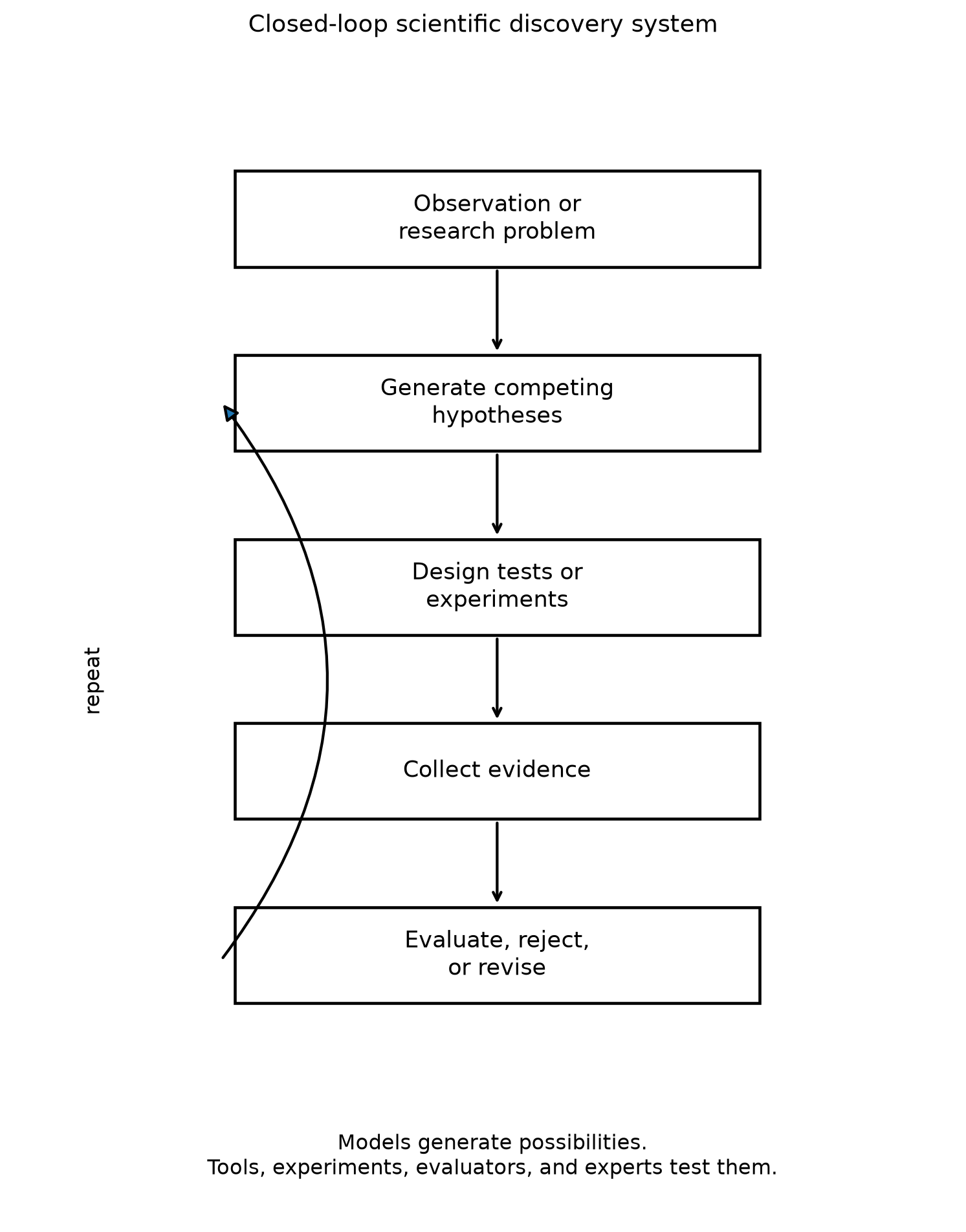
The language model generates possibilities. The surrounding system determines whether those possibilities survive contact with evidence.
Where that approach remains difficult
The evaluator may matter more than the generator. This may explain why some of the strongest results have appeared in mathematics, code and algorithm design.
In those domains, a proposal can often be:
- executed;
- formally checked;
- compared against a measurable objective;
- rejected quickly when incorrect;
- reproduced at relatively low cost.
The feedback signal is fast and comparatively objective.
Scientific discovery becomes harder when the evaluator is weak.
In medicine, climate science, economics and many experimental disciplines, tests may be slow, expensive, ethically constrained, noisy or difficult to reproduce. Important variables may remain hidden. Negative results may never be published. A statistically significant result may still fail to generalise.
The authors of the Co-Scientist study acknowledge several of these limitations.
The system depends heavily on open-access literature and may miss work hidden behind paywalls, as well as unpublished negative results. It can inherit errors from contradictory or irreproducible research, and it remains vulnerable to imperfect factuality and hallucinations.
The authors also describe its experimental validation as preliminary and emphasise the importance of provenance, external verification and rigorous peer review [5].
This is why I am hesitant to call current systems autonomous scientists.
Generating an attractive hypothesis is not the hardest part of science if the system cannot reliably determine whether that hypothesis is false.
My current view
I currently think the most useful model is this:
An LLM is a proposal engine inside a broader scientific system.
That system may include:
- language models;
- scientific databases;
- retrieval systems;
- statistical tools;
- simulations;
- formal verifiers;
- laboratory equipment;
- automated evaluators;
- provenance records;
- domain experts.
The scientific credibility of the final result does not come from the language model sounding confident.
It comes from the quality of the evidence, the reliability of the evaluator, the reproducibility of the experiment and the willingness of the system to reject its own earlier conclusions.
I do not think the evidence supports the claim that LLMs are already reliable autonomous scientists. They remain inconsistent at causal reasoning, method selection, mechanistic explanation and long-form scientific validation.
But I also do not think it is accurate to say that they can only repeat existing information.
AI systems are already helping researchers search enormous bodies of literature, generate candidate hypotheses, write and test algorithms, analyse experimental data and explore solution spaces that would be difficult for individuals to navigate manually.
The near-term future may not be a lone artificial Einstein. It may be a research environment in which models generate possibilities, tools test them, evaluators eliminate weak ideas and humans remain responsible for interpreting what survives.
What stronger evidence would look like
This perspective also changes how I would evaluate progress.
Instead of asking only whether a model can produce the same answer as a scientist, we should ask whether the complete system can:
- generate genuinely competing hypotheses;
- design tests that distinguish between them;
- recognise confounding and measurement errors;
- update its conclusions after negative evidence;
- track the provenance of every important claim;
- reproduce the result in an independent environment;
- recognise when the available evidence is insufficient.
Those behaviours would be more convincing evidence of scientific capability than another benchmark showing that a model can produce a plausible final answer.
The most important question may therefore not be:
Can an LLM make a scientific discovery by itself?
A more useful question is:
Can we build a reliable feedback loop in which AI-generated ideas are continuously tested against evidence, while plausible language is never mistaken for scientific truth?
References
[1] T. Zahavy, "Position: LLMs can't jump," in Proceedings of the 43rd International Conference on Machine Learning, 2026. [Online]. Available: https://www.tomzahavy.com/.
[2] C. Shi, X. Ren, S. Song, H. Li, R. Sheng and Y. Sun, "Are LLMs ready for scientific discovery? A capability-oriented benchmark for AI scientists," arXiv preprint arXiv:2607.11079, July 2026. [Online]. Available: https://arxiv.org/abs/2607.11079.
[3] Z. Chen, Y. Chen, C. Liu, J. Yu, X. Song, Z. Li, J. Li, P. Torr, B. Han and K. Zhang, "CausalGame: Benchmarking causal thinking of LLM agents in games," arXiv preprint arXiv:2607.04293, July 2026. [Online]. Available: https://arxiv.org/abs/2607.04293.
[4] A. Novikov et al., "AlphaEvolve: A coding agent for scientific and algorithmic discovery," arXiv preprint arXiv:2506.13131, June 2025. [Online]. Available: https://arxiv.org/abs/2506.13131.
[5] J. Gottweis et al., "Accelerating scientific discovery with Co-Scientist," Nature, vol. 655, pp. 487-496, 2026, doi: 10.1038/s41586-026-10644-y. [Online]. Available: https://doi.org/10.1038/s41586-026-10644-y.
[6] A. E. Ghareeb et al., "A multi-agent system for automating scientific discovery," Nature, vol. 655, pp. 497-505, 2026, doi: 10.1038/s41586-026-10652-y. [Online]. Available: https://doi.org/10.1038/s41586-026-10652-y.
Citation
Please cite this work as:
[1] R. Sarpong, “Can LLMs Make Scientific Discoveries?,” Richard Sarpong, Jul. 28, 2026. [Online]. Available: https://richardsarpong.com/writing/can-llms-make-scientific-discoveries/.
BibTeX
@misc{can-llms-make-scientific-discoveries,
  author = {Sarpong, Richard},
  title = { {Can LLMs Make Scientific Discoveries?} },
  year = {2026},
  month = {July},
  howpublished = {\url{https://richardsarpong.com/writing/can-llms-make-scientific-discoveries/} }
}